Projects

What I’m building at OrekGames.

Explore current projects, from private betas and open-source launches to established tools.

On deck

Next releases in the pipeline.

Private beta and open-source launch work already underway — product-native previews below, with truthful links to what you can do today.

Private beta

Project-aware coding intelligence

Orek AI

Understands the project. Makes intelligent decisions.
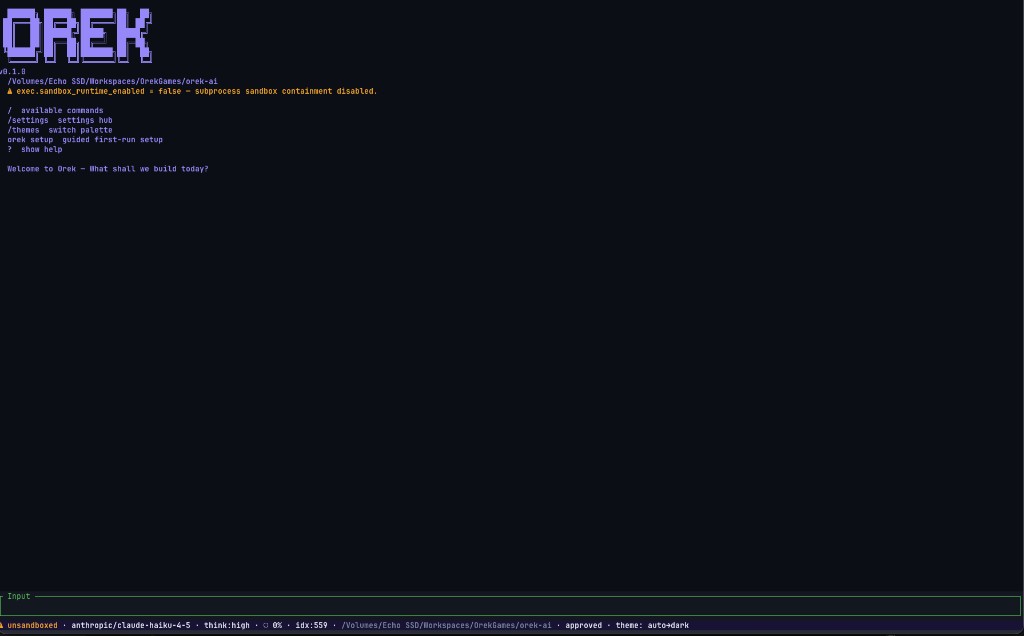
Orek terminal workspace showing its project-aware agent interface
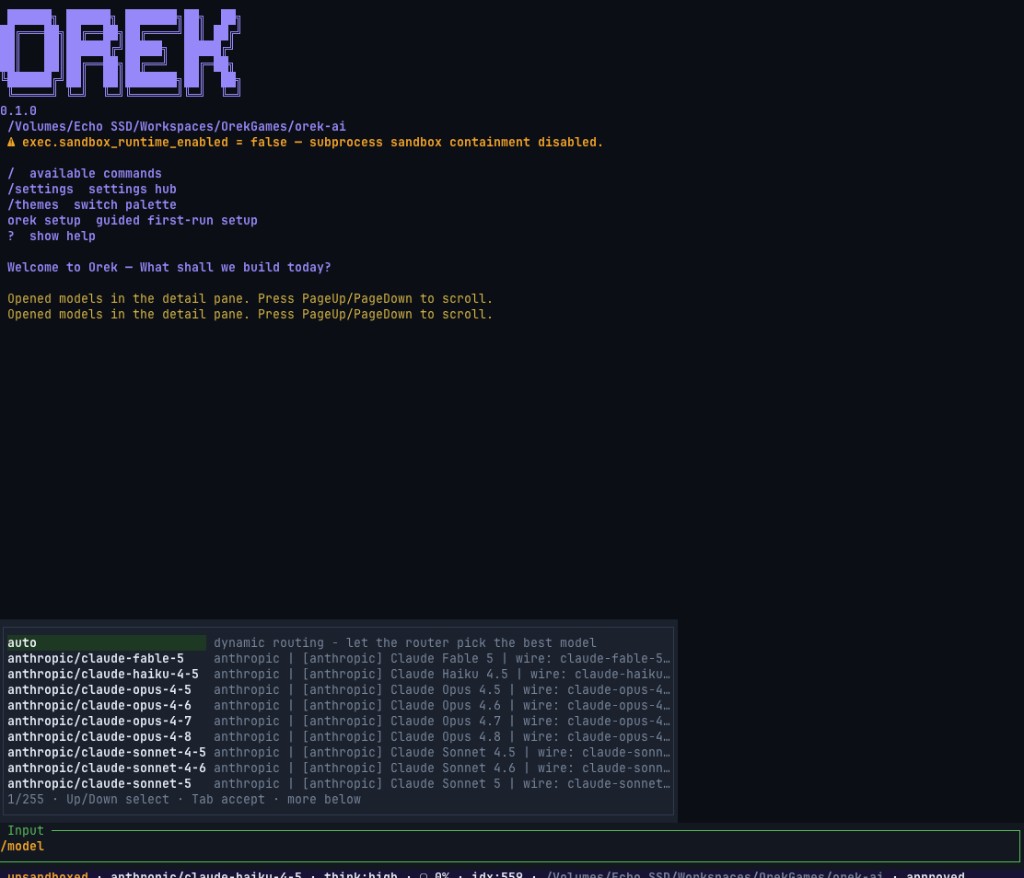
Orek model picker listing automatic routing and available Anthropic models
Model intelligence, visibleLet Orek route automatically, or take the controls.The workspace keeps project index state, the active model, execution policy, and reasoning effort in view. The model picker exposes every configured route without leaving the agent.

Orek combines a local code-intelligence layer with an adaptive LLM router. It maps the symbols and relationships in your repository, retrieves the context each turn needs, then matches the work to the best configured cloud or local model — with the final choice always visible and under your control.

How Orek thinks

  1. IndexBuilds a project-aware map of symbols and relationships
  2. RetrieveFuses semantic, full-text, lexical, and graph context
  3. RouteScores the task against configured models and constraints
  4. Act + recordUses tools under policy gates and records the decisions
  • Hybrid code intelligence — syntax-aware chunks, local code embeddings, full-text search, lexical search, and symbol-graph expansion
  • Adaptive model routing — task classification, complexity scoring, semantic matching, capability checks, and cascade selection
  • Transparent control — use automatic routing or switch provider, model, and reasoning effort directly in the TUI
  • Continuous context management — automatic compaction keeps long sessions moving and surfaces cumulative token savings
  • Configurable by design — tune routes, models, tools, permissions, retrieval, prompts, and project-specific behavior
  • Purpose-built tools beyond Bash — indexed code search, structured patches, MCP integrations, and managed subagents
Open-source launch

HTTP load testing · Rust CLI & library

pummel

Hit real workflows, not just endpoints.

Scenario validation
pummel --config auth_flow.toml --dry-run --graph
graph TD
  login --> profile
  profile --> checkout
ok  scenarios=1 steps=3 thresholds=configured
exit 0

Pummel turns YAML or TOML workflows into dependency graphs, runs them across concurrent virtual users, and reports metrics through stable exit codes that CI can gate on. Use the CLI in a pipeline or embed the same engine in a Rust test suite.

  • Workflow-shaped scenarios — dependency-aware steps, concurrent ready sets, retries, and conditional branches
  • Dynamic test data — CSV/JSON fixtures, request templates, response extractors, and per-user state
  • Built for automation — JSON output, dry-run validation, graph inspection, and pass/fail thresholds

Issue Management CLI for humans and AI agents

track

Issue and Knowledge base workflows

Pull every unresolved issue into a repeatable audit
track -o json i s "project: PROJ #Unresolved" --all \
  | jq 'group_by(.state.name)[] | "\(.[0].state.name) \(length)"'
Open         84
In Progress  12
Review        7

track turns issue trackers and knowledge bases into a scriptable execution surface: fetch every result, pipe JSON into audits, dry-run bulk plans, and resume long operations. MCP integrations are useful for interactive lookup and one-off edits; track covers the work that needs a contract: repeatable commands, shell pipelines, dry-runs, resumable state, and auditable JSON that can move from an agent session into a script, PR, or CI job.

  • Backlog-scale reads — fetch every matching issue or article with --all, then pipe JSON into jq, CI checks, reports, or notebooks
  • Reviewable bulk changes — turn create, update, comment, link, and guarded delete operations into a plan file you can validate before it touches the tracker
  • Markdown wiki publishing — publish Markdown files to YouTrack Knowledge Base or Jira/Confluence without hand-writing wiki storage markup

Documentation hosted on the project site · source on GitHub